Tennis Warm-Up for Speed, Power & Injury Prevention

two people on a tennis court ready to receive a serve
February 13, 2026

Estimated read time:

5

minutes

Dynamic warm-up for tennis: why it matters before you play

If you play tennis, whether competitively or recreationally, you already know how demanding the sport is. Quick direction changes, explosive serves, wide lunges, overhead smashes, and long rallies all require a combination of strength, mobility, coordination, and speed.

Yet many players still walk onto the court, hit a few easy balls, and call that a warm-up.

Dynamic stretching is a smarter, more effective way to prepare your body for tennis. It can:

Let’s break down why it matters and exactly how to do it.

a man is mid-overhead swing in a tennis match

What is a dynamic warm-up?

Dynamic stretching involves controlled, movement-based stretches that take your joints through their full range of motion. Unlike static stretching (holding a stretch for 30–60 seconds), dynamic stretching keeps your body moving. Research shows that completing dynamic stretching before exercise — rather than static stretching — better prepares muscles for performance.

Think:

  • Leg swings instead of touching your toes and holding
  • Arm circles instead of pulling your shoulder across your chest
  • Walking lunges instead of staying in a deep lunge position

Dynamic stretching prepares your muscles the way tennis uses them: through motion.

Why is a dynamic warm-up important for tennis players?

Tennis is explosive and multi-directional. You sprint forward, shuffle sideways, pivot, rotate, jump, and decelerate, all within seconds.

A tennis-specific dynamic warm-up supports your game in several ways:

  1. Increases Blood Flow and Core Temperature

Blood flow brings oxygen to the muscles, allowing them to maintain energy levels and improve power and reaction time. Dynamic stretching “primes” the key muscle groups utilized throughout your game, allowing them to ease into the full intensity of a match.

  1. Improves Mobility and Range of Motion

Better mobility allows for better reach for groundstrokes, stronger serves, and more efficient movement.

  1. Reduces Injury Risk

Repetitive movements during a dynamic warmup aid in prepping not only the muscles, but the nervous system as well, allowing the nerves to fire more efficiently and improve recruitment of your muscles for balance and stability.

10-minute dynamic warm-up routine for tennis players

Here is a quick and simple dynamic stretching routine to easily incorporate into your pre-game routine. Watch the video to see each exercise included below demonstrated by our professional PT team!

Box Shuffles:

The box shuffle is a quick footwork drill that helps activate your legs, improve lateral movement, and simulate directional changes you use on the court.

How to Do It

  1. Start in ready position
    Knees bent, chest up, core engaged, heels slightly off the ground.
  2. Step forward (2–3 quick steps)
    Stay low and balanced.
  3. Shuffle right (side shuffle, no crossing feet)
    Keep your hips square and shoulders stable.
  4. Backpedal to start
    Small, quick steps — don’t straighten up.
  5. Shuffle left back to original position

You’ve now traced a “box” on the court. Complete 5 times in each direction

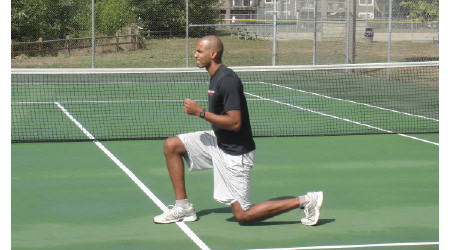
Walking lunge with Rotation:

This dynamic movement prepares your hips, glutes, core, and thoracic spine while mimicking the rotational demands of tennis strokes

How to Do It

  1. Start tall in ready position
    Engage your core, shoulders relaxed, chest up.
  2. Step forward into a lunge
    • Front knee stacked over ankle
    • Back knee drops toward the ground
    • Stay balanced and controlled
  3. Rotate toward your front leg
    • Turn your shoulders and torso over the front thigh
    • Keep hips mostly square
    • Imagine loading for a forehand or backhand
  4. Return to center
    Bring your torso back to neutral.
  5. Push through the front heel and step forward into the next lunge
    Alternate legs as you move forward.

Complete 8-10 steps on each leg.

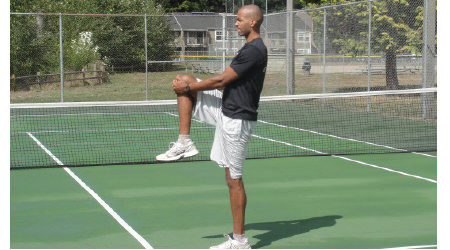
Tin Soldiers:

The Tin Soldier is a dynamic hamstring and hip mobility drill that also reinforces posture and coordination. For tennis players, it helps prepare the lower body for quick acceleration, deceleration, and long strides during wide balls.

How to Do It

  1. Stand tall
    Chest up, shoulders back, core lightly engaged.
  2. Walk forward and kick one leg straight out in front
    • Keep the kicking leg straight
    • Toes pulled up toward your shin
    • Kick only as high as you can with control
  3. Reach opposite hand toward your toes
    • Left leg up → reach with right hand
    • Right leg up → reach with left hand
      This adds core activation and mimics cross-body coordination.
  4. Step through and repeat on the other side
    Continue alternating legs as you move forward.

Complete 10-15 kicks per leg.

Sumo Lunges

Sumo lunges are excellent for preparing tennis players for lateral movement, wide base positioning, and quick direction changes. They activate the inner thighs (adductors), glutes, and hips — muscles heavily used when chasing wide balls.

How to Do It

  1. Start in a wide stance
    • Feet wider than shoulder-width
    • Toes slightly turned out
    • Chest up, core engaged
  2. Shift your weight to one side
    • Bend one knee deeply
    • Keep the opposite leg straight
    • Sit your hips back like a squat
  3. Drive back to center
    Push through the bent leg to return to the starting position.
  4. Shift to the other side
    Alternate sides in a controlled rhythm.

Complete 10-15 steps in each direction.

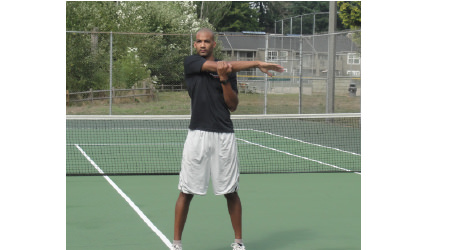
Arm Circles & Shoulder Rolls

This combination activates the shoulders, rotator cuff, upper back, and scapular stabilizers, which are critical for serves, overheads, and groundstrokes. The goal is controlled mobility, not just swinging your arms loosely.

Arm Circles

How to Do It

  1. Stand tall in athletic stance (knees slightly bent, core engaged).
  2. Extend arms straight out to your sides at shoulder height.
  3. Begin with small forward circles.
  4. Gradually increase to medium, then larger circles.
  5. Reverse direction and repeat (backward circles).

Complete 10-15 rolls each in small, medium, and large circles.

Shoulder Rolls

How to Do It

  1. Stand tall with arms relaxed at your sides.
  2. Shrug shoulders up toward ears.
  3. Roll them back and down in a smooth circular motion.
  4. Repeat several times, then switch direction (forward rolls).

Complete 10 rolls backwards, and 10 rolls forward.

How long should a tennis warm-up take?

A proper tennis dynamic warm-up only needs about 8–10 minutes. The goal is activation — not fatigue.

You should feel:

  • Warm
  • Mobile
  • Slightly elevated heart rate
  • Ready to move explosively

Final takeaway: prepare like an athlete

Dynamic stretching isn’t just for professional athletes. It’s one of the simplest ways to improve performance at any level.

Ten minutes of intentional movement can completely change how you feel on the court.

Next time you head out to play, don’t just start hitting, prepare your body like an athlete.

Your game will thank you.

headshot of two people who represent physical therapists at Therapeutic Associates PT

Ready to Play Faster and Stronger?

A smarter warm-up is just the beginning. If you want to improve performance, move more efficiently, and reduce injury risk this season, connect with a physical therapist who understands the demands of tennis. We’ll help you build a personalized plan to keep you powerful and on the court.

Blog Posts You May Be Interested In

Athletic Performance
Improve your cycling performance, prevent pain, and recover faster with expert physical therapy resources for riders of all levels.
Athletic Performance, bicycling, Cycling, injury prevention, physical therapy
Athletic Performance
Is too much training holding you back? A physical therapist explains the difference between overreaching and overtraining, and why rest is your best performance tool.
Exercise, health and wellness, injury prevention
Athletic Performance
Hands going numb? Neck tight or wrists aching on rides? Learn what’s really causing your cycling pain and how to fix it for good.
bicycling, bike fit, Exercise, hand and wrist pain, injury prevention

How can we help you today?

Quick Links: