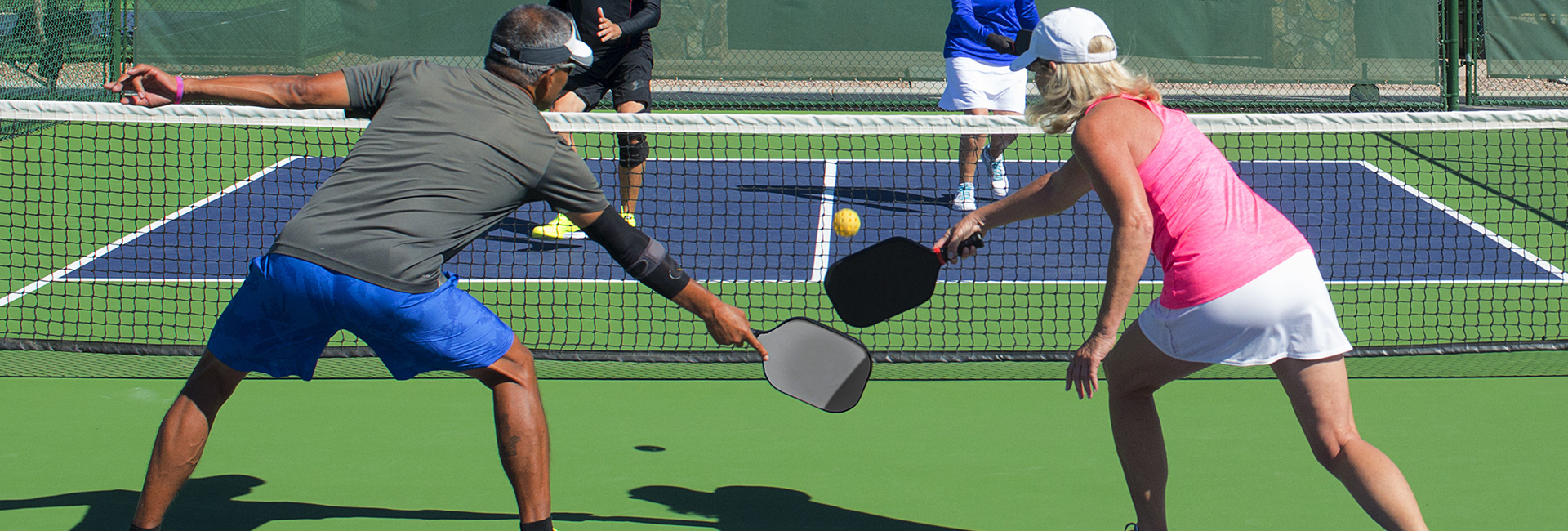

Do you enjoy playing pickleball? Or are you interested in pick(le)ing up the sport? Whether you are a seasoned pickleball player or a complete novice at the game, it is important to be aware of the common injuries that are sustained in pickleball, as well as key ways to help prevent them. Below is a list of injuries that one might (but, hopefully not) experience while playing pickleball.
Common Pickleball Injuries
- Ankle Sprain: an ankle sprain occurs most often when you step on an uneven surface (ball) or when you make a rapid and sudden movement to connect your paddle with the ball. The pain is most often felt along the outside of the ankle and is usually accompanied by swelling and/or bruising.
- Achilles Tendonitis or Tendonosis: achilles tendonitis is an inflammation of the achilles tendon that is often caused by a sudden increase in the amount or type of repetitive activity, such as going from never playing pickleball to playing it 4 times a week. Once the initial inflammatory phase of achilles tendonitis resolves, degenerative changes can occur, which is termed tendonosis.
- Stenosis: Stenosis means “narrowing”. This narrowing can occur in different places, but in unilateral sciatica (down just one leg), this is most often Lateral Stenosis. This occurs when the aforementioned lateral foramen (hole where the nerve exits the spine) is encroaching upon the nerve. This encroachment may be due to osteophytes (bone nodules), arthritis, or degenerative disk disease which can result in decreasing intervertebral disk thickness. If severe enough, this narrowing can cause compressive/rubbing irritation to the nerve.
- Shoulder Impingement or Strain: overuse of your shoulder can cause shoulder pain in in the form of impingement, where your bursa or tendon becomes irritated with repetitive use usually from repetitive overhead hits. Likewise, a slight muscle tear may occur and make it difficult to serve and hit the ball due to pain or loss of shoulder motion.
Preventing Pickleball Injuries
- Warm-up: warming up for about 5-10 minutes prior to playing pickleball will help prevent injury by gradually increasing blood circulation to your muscle. Blood carries oxygen to your muscles, which is necessary for muscle contraction. Blood also warms up your tissues, making them more extensible/flexible and less susceptible to injury. Helpful hint: warm-up your whole body! Start with a brisk walk or job and then progress to full body movements, like arm squats, lunges, and progressively larger twisting movements. Make sure you move through pain-free ranges of movement and exhale into the motion and inhale out of the motion (no prolonged holds!).
- Dynamic Stretching: after your warm up, it is important to put some stretch into the muscles you will be using to play pickleball. Begin stretching your calf muscles, quadriceps (muscles in front of your thigh), hamstrings (muscles in back of your thigh), groin, shoulders, and arms in a dynamic fashion again moving into the stretch with an exhale and moving out of the stretch using an inhale. This could mean swinging your legs side-to-side and/or doing arm and hip circles. Basically, pick any stretch you want but do not hold for prolonged periods, gently move in and out of the stretch 5-10 times. The goal is to prepare your body for movement and not necessarily to increase flexibility right before you play. That would be something to do at home after activity or before going to bed.
- Proper footwear: wearing shoes designed for court sports may help you prevent injury. Speak to a specialty footwear representative for additional information.
- Listen to your body: When starting pickleball it would be considered normal to “feel” muscles that you may not have used in a particular way in a while. If your intuition tells you that you are experiencing an “unreasonable” amount of discomfort during or after playing, take a few days off and give it a break. If your symptoms persist and haven’t changed with relative rest potentially some icing consider having a PT or physician evaluate you. We have found the sooner this can be addressed looking for the root cause of the issue, the less time you will spend in the long run dealing with it.
Physical Therapy Can Help!
If you are currently experiencing pain or loss of function due to an acute or nagging pickleball injury, consider making an appointment to see a physical therapist today. Physical therapists can help you identify the root cause of your symptoms, manage the pain, promote the healing process, and facilitate improved movement and mobility of your joints and surrounding tissues. Physical therapists are trained to help you get back to playing the game you love and can assist you in preventing further injury. In the state of Oregon you can refer yourself directly to a physical therapist without a physician’s referral.
References
- USAPA Pickleball. Access May 2nd, 2018 at https://www.usapa.org/health-safety/
- American Heart Association. Accessed May 3, 2018 https://healthyforgood.heart.org/move-more/articles/warm-up-cool-down
Start your journey to pain-free living today.
Our experts are committed to providing effective, efficient, and compassionate care to help you live a pain-free, active life. Our passion is to help every patient reach their goals on their journey to recovery and optimal performance.